
Nostalgic Moments
How Looking Back Can Help Us See the Present

We’re living in wild times, dear reader. Is it just me, or does everything feel like it’s moving and changing very quickly? Tech advancements—especially AI—seem to be moving at the speed of light. And some days, I feel like I can barely keep up with all the various apps that send me messages (and you want me to join you on Slack too?). So it only seems fitting that this week’s prompt is about nostalgia.
The prompt today is one that really resonated with a lot of my participants, and produced a wide variety of responses. It offers that wonderful surprise that only generative free-writing can bring, what Pat Schneider called the “diving board,” in her book, Writing Alone and with Others. She writes:
Remember that an exercise is just a diving board into the "dreaming place." Start with the suggestion, but always be open to the delicate appearance of something else—something deeper. As soon as that something else appears at the edge of your consciousness, abandon the exercise, and keep writing what that inner vision offers.
Today’s diving board is the following prompt about the term “nostalgia,” and the ways its meaning has changed over the years. Read the short paragraphs below, and write in response for 20 minutes, whatever comes to mind.
What I wrote follows the prompt, and Dawn Potter’s poem finishes off today’s post.
Enjoy.
The Prompt:
Nostalgia was once thought of as a treatable mental illness, and its symptoms included loss of appetite and a desire to return to one's home country.
When we think of nostalgia today, we tend to think of sentimental childhood memories, often associated with bittersweet joy; however, during the Civil War, it was known as a perplexing condition that, according to the Jeffersonian Newspaper, was a frequent killer of soldiers.
Many newspapers reported the symptoms of nostalgia at the time. One popular paper, the Cleveland Morning Leader, described a soldier talking in his sleep, hallucinations of wartime, and insanity. It discussed how without treatment—in this instance, being sent home—he would likely have died by suicide. The Plymouth Democrat wrote of soldiers sinking into “utter inaction and depression” in an “epidemic fashion.”
Over time, nostalgia became less an acute homesickness for a specific place, and more a sentimental longing for the past. Nostalgic memories, often partially recalled, usually evoke pleasant associations and simultaneous regret at the passing of time. But 160 years ago, nostalgia was almost a virtuous illness to have, because it showed that you cared about the right things.
What I wrote in Response:
I can't help it: I miss the old days. I liked it when you had to sit and talk on the telephone, before there were speaker phones, before they all went chordless. I liked having a server come to the table with a check, not simply swivel a screen in your direction, or direct me on how to use the kiosk or the QR code.
I liked it when cars didn't drive themselves, refrigerators didn't beep or tell you the temperature, when banks were places people went inside, sat down, and talked quietly. When crosswalks didn't light up, and planes served free food (and only offered one movie).
I can still remember how everyone had to be ready by 7:00 p.m. to watch TV on one of only four channels, how we shushed one another because people understood that you had to pay attention or you would miss an important line of dialogue. There was no rewind button, only commercial breaks and intro credits, and no such thing as cable.
I know it was a complicated time too, politically: glass ceilings and school bussing and people fighting for gay rights. Seatbelt safety was in its infancy, and there were no airbags to save your life. But because there was no GPS, you had to watch the road, to pull over, to ask for directions. You had to pay attention to landmarks and street signs and the numbers on the buildings. "Do you have any white out?" my guy asked me recently, and I thought, Now that's a man after my own heart. But of course, I didn't have white out. Do they even sell it anymore?
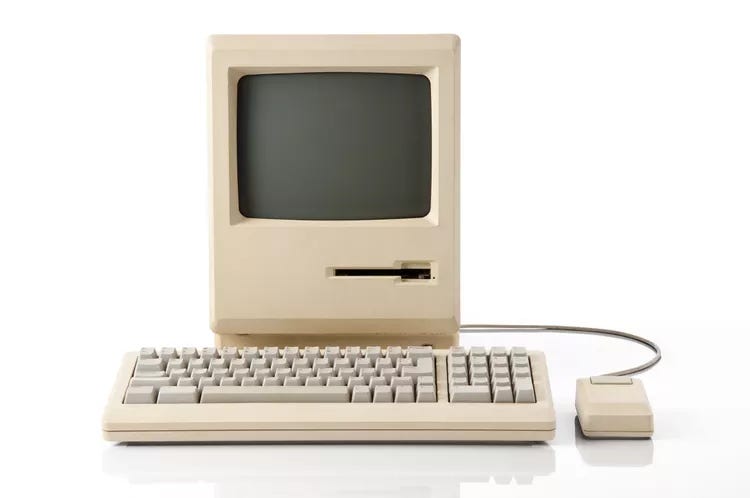
Don't get me wrong, I don't miss waving my hand at the white liquid drying on the typed page; I fell in love with the delete button on the first Apple “Macintosh” when they included them in the brand new computer lab on the top floor of my college library. I thought floppy disks and CDs were magic. And I still remember the first time I used an ATM and felt like I was in the Jetsons. But it all went downhill from there.
I recently heard someone say that AI can't replace craftspeople and laborers, and I thought, Not yet. However, would I have preferred a friendly robot to the emotionless face of the young woman at the coffee shop today? Most likely. Especially when she said, "We'll be there in a minute," sounding very annoyed, as if we customers were an inconvenience.
In a recent study that placed robot companions in retirement centers, every elderly person said the thing they loved best about their mechanical roommate was that they were always friendly and polite (and always laughed at their jokes). People say something similar about self-driving cars: they follow the traffic rules. I wonder how they’ll feel about robotic dogs when they are used regularly by the police and the army.
It's a weird and scary new world, but it’s the only one we’ve got.
Nostalgia
by Dawn Potter

It was darker then, in the nights when the cars
Came sliding around the traffic circle, when the headlights
Speckled with rain traveled the bedroom walls
and vanished; when the typewriter, the squeaking chair,
the slow voice of the radio stirred the night air like a fan.
Of course, the ones we loved were beautiful—
slim, dark-haired, intent on their books.
The rain came swishing against the lamp-lit windows.
The cat purred in his chair. A clock sang,
and we lay nearly asleep, almost dreaming,
almost alone, nearly gone—the days fly so;
and the nights, like sleep, disappear without memory.